Secondary Clarifier For Wastewater Treatment In India
Biological treatment does the heavy lifting when it comes to breaking down organic matter in wastewater, but on its own, that process doesn't leave you with clean, dischargeable water. What it actually produces is a mix of treated water and biological sludge that still needs separating out. That's where a secondary clarifier steps in. It's the quiet settling stage that ends up deciding whether the rest of your plant is actually doing what it's supposed to, and at Aquagreen Tech Solutions, we build clarifiers to handle that job properly, not just adequately.
We manufacture and supply secondary clarifiers for STPs and ETPs across India, working with industries, institutions, housing societies, and commercial setups that need dependable solid-liquid separation once biological treatment is done. Every clarifier we deliver goes through our full project process—design & engineering, manufacturing & fabrication, installation & commissioning, testing & compliance support, and annual maintenance & after-sales service once it's actually part of your plant.
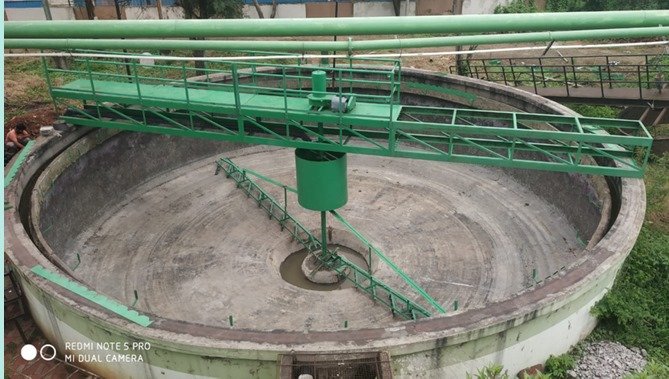
What is a Secondary Clarifier?
A secondary clarifier is basically a settling tank positioned right after the biological treatment stage of a wastewater plant — it doesn't matter much whether you're running an activated sludge process, MBBR, or SBR system. Its whole job is to give the biological floc, those clumps of microorganisms that just spent their energy breaking down organic pollutants, enough time to settle out of the water under gravity, separating it from the clear treated water sitting on top.
The sludge that settles out collects down at the bottom, and from there it's either sent back into the biological process to keep the microbial population active or drawn off as excess sludge to be handled separately. What comes out over the top is the clarified water, ready to move on to polishing, disinfection, or discharge, whichever your setup requires. And if you skip having a well-designed secondary clarifier, biological treatment just ends up handing you back water that's still full of suspended solids — which more or less undoes the whole point of treating it in the first place.
Comprehensive Secondary Clarifier Solutions
Every clarifier we build starts with real design & engineering—we work out the settling velocity, surface loading rate, and sludge characteristics specific to your plant, rather than just pulling a standard tank size off the shelf. From there, our Manufacturing & Fabrication process uses corrosion-resistant materials, properly engineered scraper mechanisms, and inlet-outlet arrangements that actually hold up, so the clarifier performs the way it's supposed to under real operating conditions, not just on a spec sheet.
Growing Need for Secondary Clarifiers Across India
More STPs and ETPs are coming online across India all the time — pushed along by urban development, tighter discharge norms, and growing industrial output — and demand for reliable secondary clarification has grown right along with it. Housing societies and townships need consistent effluent quality to satisfy local body requirements. Industries in sectors like textiles, food processing, and pharmaceuticals need clarifiers that can handle sludge loads that don't stay constant without letting output quality slip. And as pollution control boards keep tightening enforcement around discharge standards, a properly functioning secondary clarifier has basically become non-negotiable for any biological treatment setup.
Secondary Clarification Process
Water carrying biological floc from the aeration or bioreactor stage flows into the clarifier and slows down considerably, giving the heavier flocs time to settle under gravity. Down at the base, a rotating scraper mechanism gently pushes the settled sludge toward a central hopper, where it gets drawn off—most of it heading back into the biological process as return activated sludge, with the rest wasted out. Meanwhile, the clarified water rises up and flows out over a weir, moving on to the next treatment stage or straight out to discharge.
Key Features of Our Secondary Clarifier Systems
- Settling and surface loading rates worked out around your specific sludge characteristics
- Corrosion-resistant tank construction meant to hold up under continuous operation
- Scraper and sludge-removal mechanisms that don't need constant manual intervention
- Inlet and outlet zones designed to avoid short-circuiting and turbulence
- Sizes that scale from smaller STP applications up to large industrial ETPs
Benefits of Installing a Secondary Clarifier
A properly designed secondary clarifier keeps your effluent quality steady, which matters both for staying compliant and for protecting whatever treatment stage comes next, like filtration or disinfection. It also keeps your biological treatment process healthy, since efficient sludge return is what maintains the microbial population your whole system depends on. Beyond just ticking the compliance box, a clarifier that's actually working well takes pressure off downstream equipment, cuts down on unplanned maintenance, and stretches out the working life of your entire treatment plant.
Our Services
- Installation & Commissioning – Our own engineering team handles the on-site setup, making sure the clarifier fits cleanly into your existing treatment train from day one.
- AMC – Annual Maintenance Contract – Regular servicing and preventive checks that keep your clarifier, and the rest of your plant, running at the efficiency it was built for, year after year.
- O&M—Operation & Process Maintenance—If you'd rather we stay hands-on day to day, we can manage plant operation directly for you.
- Consultancy Services – Whether it's process design or sludge management strategy, our team is there to help you work through the decisions that actually matter.
Why Choose Aquagreen Tech Solutions?
We build secondary clarifiers the same way we build every other part of a treatment plant — around real site data, not a generic spec sheet. Every unit goes through proper testing & compliance support before we consider it done, checking settling performance and effluent clarity so what you get actually works the way it's meant to. And we don't step back once it's installed, either—our support team and annual maintenance & after-sales service stay involved, keeping your clarifier performing reliably and protecting the investment you've made in the rest of your plant.
Looking for a secondary clarifier built around what your site actually needs? Take a look at our dedicated secondary clarifier for wastewater treatment in Pune page for region-specific details, or just get in touch, and we'll talk through your plant's requirements.